
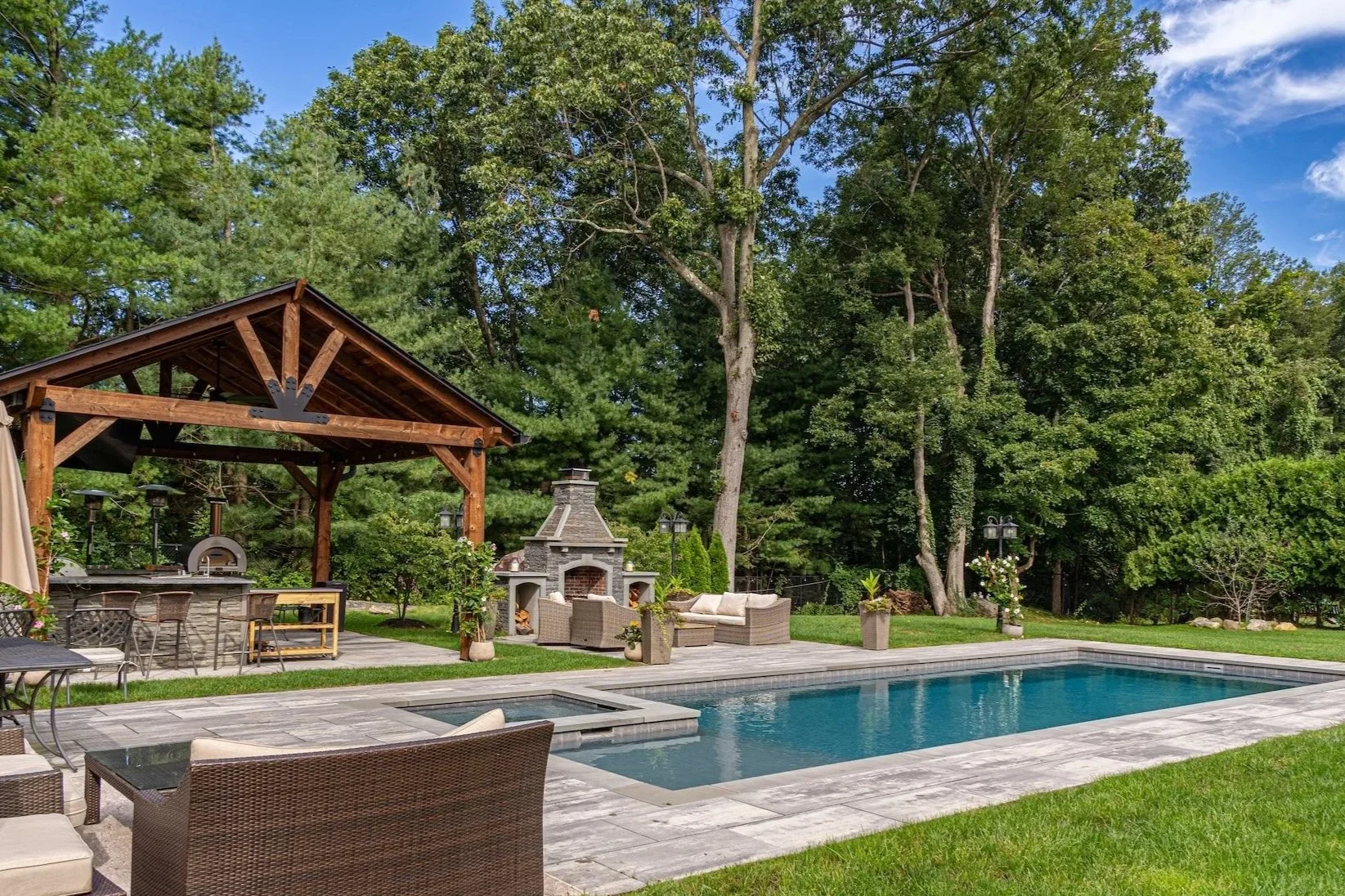
Most backyard projects in the Hudson Valley are planned around July. The pool gets sized for August afternoons, the patio gets laid out for summer dinners, and by the second week of October the whole space sits unused until Memorial Day. Working with an outdoor living contractor in Salisbury Mills, NY, changes that calculation, because the decisions that open up spring and fall are made early, during design, and they are difficult to add later. A backyard that earns its cost is one you walk into in April and again in November.
Jamie Albert Snyder has been doing landscape and swimming pool design work since 1995 and started Albert Group Landscaping, Inc. in 2005, which means our team has watched two decades of Hudson Valley backyards go through freeze, thaw, drought and downpour.
That history shapes how we plan a property. We know which surfaces stay usable in shoulder season, which plantings hold structure after the first hard frost, and where water goes when a spring storm drops two inches on saturated ground in Orange County.
This article covers what a four-season backyard actually requires, how site conditions shape it before a single feature is chosen, and what changes when one contractor handles the pool, the hardscape and the landscape together.
What Does an Outdoor Living Contractor Handle That a Pool Contractor Alone Does Not?
A pool contractor delivers a pool. An outdoor living contractor delivers the space that surrounds it, which is where most of the hours of use actually happen. The swimming season in Salisbury Mills runs roughly late May through mid September without heating. The patio, the shade structure, the fire feature, the lighting and the walkways run considerably longer, and they carry the property through the months when nobody is getting in the water.
That difference shows up in scope. A single contractor plans grading, drainage, excavation, pool shell placement, decking, retaining walls, walkways, planting beds, lighting and irrigation as one sequence rather than as separate jobs handed between trades. Our team builds patios, outdoor kitchens, walkways and retaining walls alongside the pools we install, so the surfaces around the water are designed at the same time as the water itself.
It also shows up in what gets decided first. A pool-only scope sets the pool location and lets everything else fall into whatever space remains. A full outdoor living scope starts with how you want to move through the property across the year, then places the pool inside that plan. Those two approaches often produce different pool positions on the same lot.
The third difference is accountability. When separate companies handle excavation, the pool, the hardscape and the planting, a settled paver or a wet corner belongs to whoever the other trades point at. One contractor carrying the whole scope has nobody to point at, and the sequencing decisions that cause those problems were made by the same team that has to answer for them.
Why Does Four-Season Use Start With Grade and Drainage Rather Than Features?
Properties around Salisbury Mills sit on varied terrain, and much of Orange County carries dense soils that hold water rather than shed it. A backyard that drains poorly in March is a backyard you do not use in March, regardless of how good the furniture is. Grade and drainage determine whether the shoulder seasons are available at all, and they are the least visible part of the budget.
Positive drainage away from the house, the patio and the pool deck is the baseline. Beyond that, the questions are where the water collects during snowmelt, whether a slope needs a retaining wall to create usable flat ground, and how runoff from the roof and driveway crosses the yard. A retaining wall often does double duty here, solving an awkward slope while creating a defined terrace that becomes the most used surface on the property.
Frost depth matters just as much. Footings for pavilions, pergolas, outdoor kitchens and freestanding walls need to sit below the local frost line, or the freeze-thaw cycle lifts and cracks them over a few winters. Pool decks need control joints and a base depth suited to soil that moves. These are not upgrades. They are the reason a five-year-old patio in the Hudson Valley either looks correct or looks tired.
Which Features Actually Extend a Salisbury Mills Backyard Into Fall and Spring?
Three categories do most of the work: heat, light and shelter. Each one adds usable weeks on both ends of the season, and each one is far cheaper to install during the original build than to retrofit into finished hardscape.
How Much Season Does Added Heat Buy?
Heat is the most direct. A built-in fire pit or a gas fire table gives a gathering point on a fifty-degree October evening. A covered structure with an overhead heater pushes that further into November.
For the pool itself, a heater and an automatic cover together often add six to eight weeks of swimming across the two shoulder seasons, since the cover holds overnight heat that would otherwise be lost.
Why Does Lighting Matter More Than Homeowners Expect?
Light is the least expensive and the most underestimated. Sunset in Salisbury Mills falls before five o'clock in late autumn, which puts the entire usable evening after dark.
Low-voltage lighting on steps, walls, walkways and specimen trees turns that darkness into something you can occupy safely. It also makes the space visible from inside the house during winter, which matters more than people expect.
What Does Shelter Add on the Shoulder Days?
Shelter covers pavilions, pergolas with retractable canopies and simple roof extensions off the house. A covered surface handles light rain, autumn wind and August sun with equal usefulness. Pairing shelter with an outdoor kitchen keeps cooking outside well past the point where an open grill stops being pleasant.
Controls tie all three together. Zoned lighting, a heater on a timer and a pool cover on an automatic switch mean the space is ready when you decide to use it rather than twenty minutes later, and that gap is usually the difference between going outside on a cool evening and staying in. Running the wiring for those controls during the build is straightforward. Adding it under a finished patio is not.
How Do Sun, Wind and Snow Exposure Change Where Features Go?
Orientation decides how many months a given surface is comfortable, and it costs nothing to get right at the design stage. A patio on the north side of a house in Salisbury Mills sits in shade for most of the shoulder season and stays damp after rain. The same surface on a south or southwest exposure picks up low autumn sun and dries quickly, which often makes it usable a month longer at each end of the year.
Wind is the variable most homeowners overlook. Exposed ground on a rise or an open field edge is pleasant in August and unpleasant in October, and a fire feature in a wind channel is more smoke than warmth. A wall, a planting mass or a partial screen on the prevailing side changes the comfort of a seating area substantially, and the prevailing direction in the Hudson Valley is generally from the northwest in the colder months.
Snow handling is the winter version of the same question. Where the plow or the shovel puts snow determines which plantings survive and which walkways stay clear. Locating the primary path to the door away from the snow storage area, and keeping delicate material out of that zone, avoids a yearly cycle of replacement. Roof runoff and ice fall from an eave belong in the same conversation, since a walkway placed directly under an unguttered edge becomes a hazard every February.
How Do Material Choices Change When a Backyard Is Built for Winter?
Every hard surface in a Hudson Valley backyard goes through dozens of freeze-thaw cycles per year. Water enters the pores of a paver or a stone, expands as it freezes, and works the material apart over time. Material selection is where a four-season backyard either holds up or starts spalling in year three.
Which Surfaces Hold Up Through Freeze and Thaw?
Dense, low-absorption products handle this better. Concrete pavers rated for northern climates, dense natural stone and properly sealed surfaces resist the cycle in ways that softer or more porous options do not. Joint material matters too, since polymeric sand that has failed lets water sit under the surface where it does the most damage.
Surface texture is a comfort question as well as a durability one. A dense, smooth stone that is pleasant underfoot in July can be slick in shoulder season when it holds morning moisture, particularly on steps and around the pool edge. A lightly textured finish on the surfaces you walk on in April and October gives up very little in appearance and makes those months safer.
How Should De-Icing Be Handled on a New Patio?
De-icing products are the second variable. Rock salt is hard on both concrete and adjacent plantings, and the runoff ends up in the beds beside the walkway.
Calcium chloride or magnesium chloride in measured amounts generally treats surfaces more gently, and a walkway designed with adequate slope needs less de-icer to begin with.
What About the Coping and the Pool Deck?
Coping and pool decking deserve particular attention because they take the most water. A coping detail that sheds water away from the shell, set on a properly compacted base, holds its line through the winter.
Fiberglass helps on the shell side, since the material flexes rather than cracking under ground movement, and our team partners with Leisure Pools for the fiberglass pools we install.

How Does Planting Design Support a Backyard You Use Year Round?
A planting plan built entirely around June bloom leaves the property looking bare for seven months. Four-season planting design weights structure and winter interest more heavily, which changes the plant list considerably.
Which Plants Carry the Property Through Winter?
Evergreens carry the winter, providing mass, screening and color when the deciduous material is bare. Ornamental grasses hold their form through snow and move in wind, adding something to look at from a kitchen window in February. Trees and shrubs with strong bark, persistent berries or interesting branching structure keep the beds reading as designed rather than as empty.
Bed edges and mulch choice affect how the beds read in winter as well. A crisp cut edge or a stone edge holds a defined line under snow, while a soft edge disappears and makes the whole planting look unfinished from November onward.
Mulch that breaks down quickly needs refreshing before the beds look right again in spring, so a longer-lasting material generally serves a four-season plan better.
What Changes in the Beds Closest to the Pool?
Around a pool, the selection tightens further. Plants that drop heavy leaf litter, shed needles or attract bees near seating create ongoing maintenance and mild nuisance. Deep-rooted species too close to the shell or the plumbing create larger problems. Setting the planting beds at a workable distance from the water, with the maintenance path built in, keeps the space easy to live with.
How Should Privacy Screening Be Planted?
Screening is the last piece. Layered evergreen and deciduous planting along a property line gives summer privacy and winter structure at once, and it usually reads better than a fence on a rural or semi-rural Salisbury Mills lot.
What Does the Design Process Look Like With a Single Contractor?
The practical advantage of one contractor is that nobody hands the project off mid-sequence. Excavation, pool set, utility runs, hardscape base, decking, walls, planting and lighting happen in an order where each stage prepares the next, and a change in one stage gets reflected in the others without a renegotiation.
Our process starts with listening. Jamie does a substantial amount of writing during a first meeting, working out what a homeowner wants and what they do not want before any design work begins, because those notes drive the first drawing. Most projects are won on that first design, and the reason is the intake rather than the rendering.
After the design is presented, the project moves to an upfront price with a payment schedule and a proposed start and finish date. Knowing the sequence in advance also lets a project be phased sensibly if that suits the budget: pool, deck and drainage in year one, then the outdoor kitchen, pavilion or expanded planting in year two, with conduit and utility stubs already in place so the later work does not require breaking finished surfaces.
That last point is the strongest argument for planning the full space at the start even if you build it over several seasons. Running a gas line, an electrical conduit and a water line before the patio goes down costs comparatively little. Cutting them in afterward costs a great deal more and rarely looks as good.
When Should a Salisbury Mills Project Start If You Want to Use It Next Season?
Design, permitting and scheduling all take time, and the calendar in the Hudson Valley is unforgiving at both ends. Design and revisions typically run several weeks. Municipal permitting for a pool adds more, and the local review calendar is busiest in spring when every homeowner in Orange County has reached the same conclusion at the same time.
Construction itself is weather dependent. Excavation in saturated ground is slow and messy, concrete and mortar work has temperature limits, and planting has its own preferred windows. Fall and winter are useful months for design, permitting and contracts precisely because they are not useful months for digging.
Homeowners who start conversations in autumn generally have a completed design and an approved permit before the spring build season opens, which puts them at the front of the schedule rather than waiting behind it. Homeowners who start in May are typically looking at the following year for anything substantial.
Plan Your Salisbury Mills Outdoor Living Project With Albert Group Pools & Patios
If you want a backyard that works in October and April, not only in July, the plan for it starts now.
Reach out to Albert Group Pools & Patios to talk through your property with an outdoor living contractor who handles the pool, the hardscape and the landscape as one project.
We’ll walk the site, listen to how you want to use the space across the year, and come back with a design, an upfront price and a schedule you can hold us to.
In Summary
Does a four-season backyard cost significantly more than a summer-only one?
Not proportionally. Drainage, frost-depth footings and utility conduit are a modest share of a total project budget when they are built in from the start, and they are the items that make later additions affordable. The expensive version is retrofitting heat, light and shelter into finished hardscape, which often means demolition. Planning the full scope up front and building it in phases usually costs less overall than building twice.
Can an outdoor living project be added to a pool that is already installed?
Usually though, the options narrow. An existing pool fixes the deck elevation, the equipment location and the traffic pattern, which limits where a pavilion, kitchen or wall can sensibly go. Albert Group Pools & Patios regularly works on properties with existing pools, and the first step is assessing grade, drainage and utility access before proposing anything.
How far outside Salisbury Mills does a project like this travel?
Our team works across Orange County and into Westchester, Dutchess, Ulster, Putnam and the surrounding Hudson Valley areas. Travel distance affects scheduling more than feasibility. The site conditions that matter, meaning soil, slope, drainage and frost depth, are broadly similar across the region.
Do outdoor kitchens and fire features need a permit in Orange County?
Frequently, and it depends on the municipality and the specifics of the installation. Gas lines, electrical runs, permanent structures and anything within a setback typically trigger review, while a portable fire table generally does not. Handling permitting as part of the project scope avoids the situation where a finished feature has to be modified after the fact.
Related: Elevate Your Outdoor Living: Why Backyard Pools Are Your Next Big Home Upgrade in Bedford Hills, NY